The owner of a small Italian restaurant in Sevilla types review gating tool into Google after watching a single bad night turn into three one-star reviews from a couple who, in fairness, ordered a complicated off-menu dish on a Tuesday when the chef called in sick. The owner is not trying to defraud anyone. They are trying to keep one bad Tuesday from outweighing six months of careful cooking. The tool that promises to "intercept unhappy customers before they reach Google" sounds, in that moment, like common sense.
It is not common sense. It is the canonical pattern Google's 2026 review policy was written to suppress, and using it is likely to make the restaurant's situation worse, not better. This article explains what review gating is in clear terms, why platforms moved against it, what enforcement actually looks like in 2026, and what an honest alternative is for the restaurant owner who started this paragraph.
Review gating was always a workaround for a deeper problem. The platforms have stopped tolerating it because the problem — distorted public review distributions — is now too valuable to ignore.
What review gating actually is
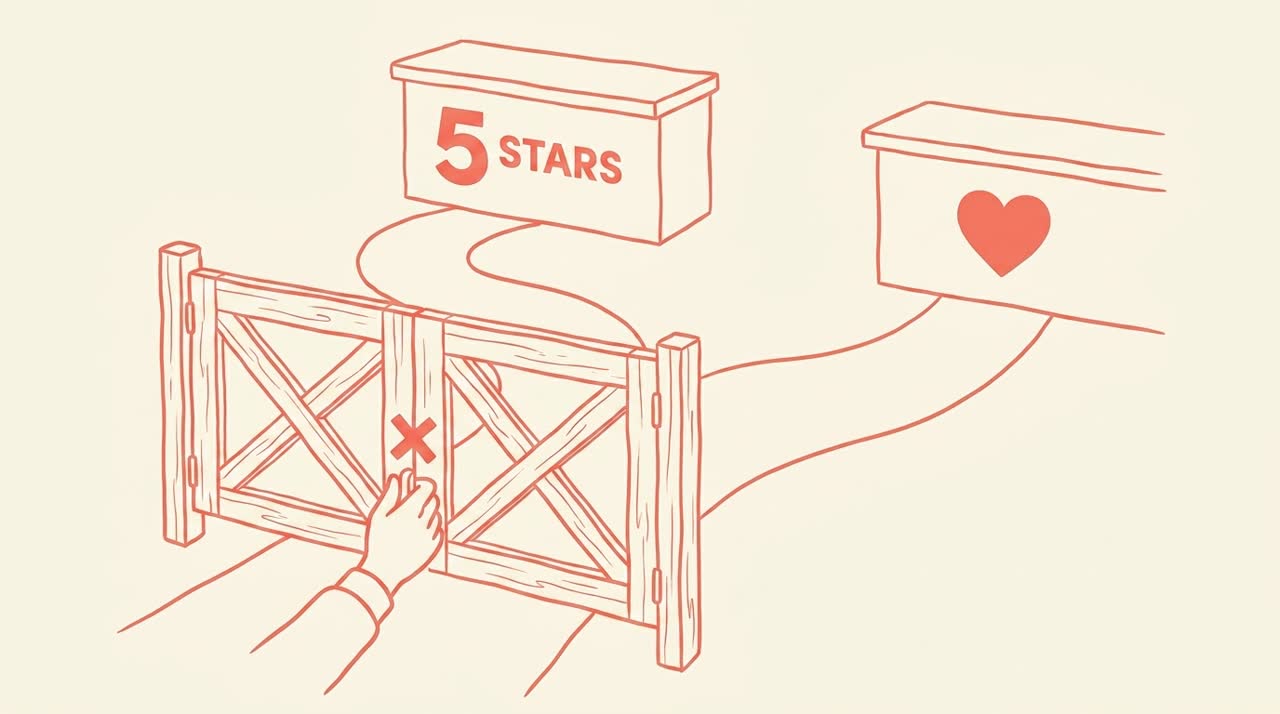
The technical pattern is simple. A business sends a customer — usually after a transaction — a link or message that lands them on a screen with a question: How was your experience? Sometimes phrased as a star rating, sometimes as a thumbs-up versus thumbs-down, sometimes as an open-ended prompt. The tool then routes the customer to one of two destinations based on the answer:
- A four- or five-star answer redirects the customer to the public Google or Trustpilot review form, where they will probably write something positive in line with what they just clicked.
- A one-, two-, or three-star answer routes the customer to a private feedback form that the business owner monitors — and that the public never sees.
The result, predictably: the public Google rating overrepresents satisfied customers, sometimes dramatically. Businesses that gate reviews systematically can move from a true 3.8-star rating to a displayed 4.7, which is the difference between "people are mostly happy" and "this is the best place in town."
Why platforms moved against it
The 2024 Google policy refresh and the 2026 enforcement update were not isolated events. They were responses to two converging pressures.
First, the rise of AI search. Perplexity, ChatGPT Search, Google AI Overviews, and Claude all increasingly cite Google reviews as ground truth when answering questions about local businesses. A 2026 MapAtlas analysis found that approximately 60% of US searches now trigger an AI Overview, and reviews from the last 30 days are weighted disproportionately in those Overviews. If the public review distribution is gated, every downstream AI answer inherits the distortion. That is a product problem for Google, not just a policy one.
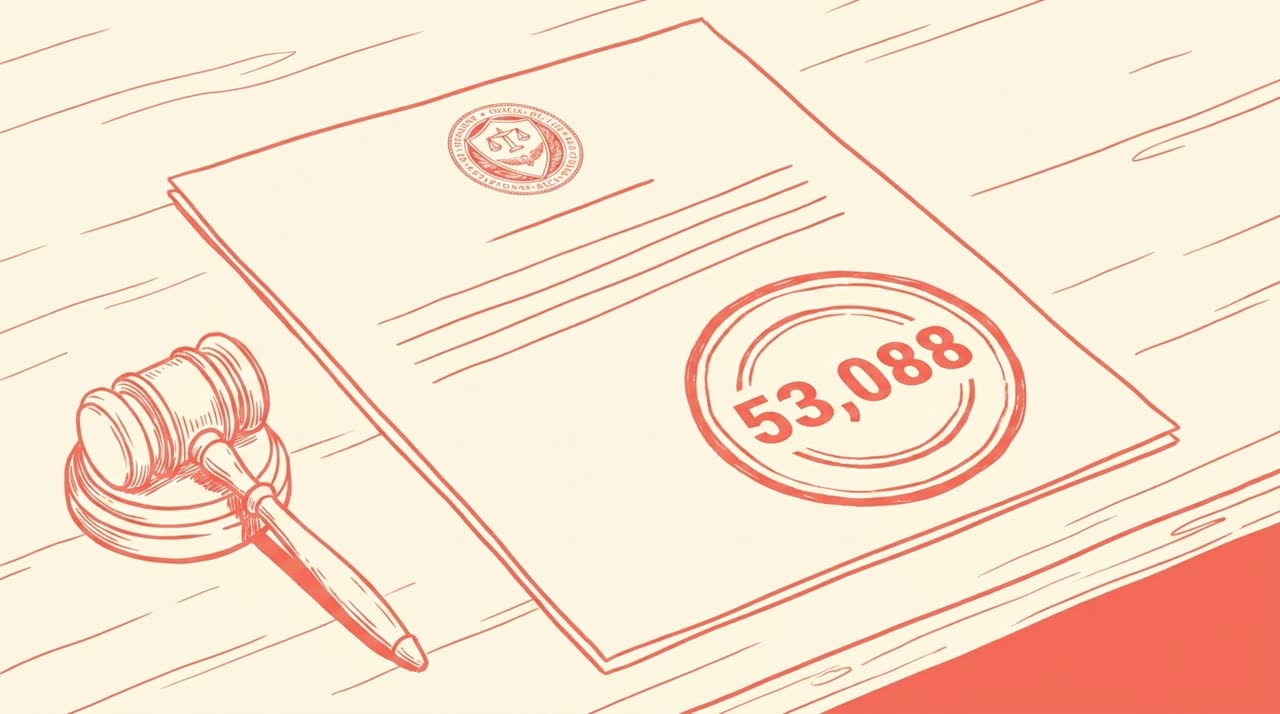
Second, consumer trust. The 2024 FTC final rule on fake and manipulated reviews — which carries civil penalties of up to roughly $51,000 per violation in 2026 — was the first federal-level enforcement framework that explicitly named practices like incentivized positive reviews and review suppression. Even where review gating is not directly named, the FTC's framework against "deceptive review collection" applies. Surveys at the same time showed consumer trust in Google reviews dropping sharply when respondents learned how common gating had become. Google's response was both reputational and product-driven.
What enforcement looks like in 2026
Documented enforcement actions, drawn from public Google Business Profile community threads, agency case studies, and appearances in Google's transparency reports, include:
- Bulk removal of reviews collected via gated workflows. Google's spam systems can identify the characteristic pattern (concentrated 4-5 star reviews arriving from the same domain or referrer over a short window) and remove them in batches.
- Suppression of the business listing in Maps results. The business does not disappear, but it drops in ranking — sometimes by enough to wipe out the gating gains and then some.
- Suspension of the Google Business Profile. The most severe action short of a full ban. The business loses access to its Maps listing entirely until it can appeal — an appeal that, in 2026, is harder to win than it was in 2022.
- Permanent bans for repeat offenders. Recovery typically requires moving to a new business legal entity and a new physical address. For a single- location SMB, this is often functionally impossible.
None of this is theoretical. It is documented, ongoing, and accelerating. The agency that promises to "boost your rating risk-free" is selling a product whose risk profile is materially worse than it was four years ago.
Why the demand for review gating remains real
The honest part of this article is that the SMB owner Googling "review gating tool" is not a villain. They are looking at a system where:
- One bad shift outweighs six months of good ones in the public rating, because reviews accumulate slowly and one-star reviews are stickier than five-star reviews.
- Customers with bad experiences are more motivated to write reviews than customers with good ones — what the academic literature calls the negativity bias in unsolicited feedback.
- The platforms that profit from the reviews provide little recourse when a clearly-unfair review (a customer angry about something not in the business's control) lands and stays.
That is a real problem. Review gating is the wrong solution, but the problem is real.

The honest alternatives
Three approaches that work, ordered by leverage:
- Reduce review friction for satisfied customers. The mechanism: most customers who had a good experience never leave a review because the link to the form is awkward to share. A short, branded URL on the receipt or table card removes that friction. The distribution shifts toward reality not because you filtered the unhappy ones out, but because you brought the happy ones in. This is the legitimate version of what gating tools were trying to do — and it is what BigLove is built for.
- Respond to negative reviews promptly and publicly. Google's review system shows the business response next to the review. A thoughtful, specific, non-defensive response to a one-star complaint can turn the public-facing impact of that review around almost completely. The customer who wrote it may even update their rating after seeing the response — Google allows it, and survey data suggests around 12-15% of one-star reviewers do change their rating when met with a real reply.
- Improve the underlying experience where one-star reviews come from. Slow tables, missed orders, cold food, distracted service — these are operational, not marketing problems. Reading the actual text of one-star reviews and treating it as customer research is the slow, unglamorous version of fixing the rating. It also has the side effect of fixing the business.
What a compliant review link actually does
A compliant review link tool — and BigLove is one of
them — is architecturally simple. It maps a memorable URL
like biglove.to/your-business to your canonical
Google or Trustpilot review form. When a customer scans the
QR code on the receipt or types the URL, they are redirected
in a single HTTP step to the same form they would reach by
searching for the business on Google Maps and clicking
Write a review. Nothing in the BigLove path asks
them to rate first. Nothing routes them based on a
pre-screening question. The review they write goes directly
to Google.
That is it. That is the whole product. The compliance comes from the architecture: there is no gate to enforce a policy about. For a deeper walkthrough, see our compliance page or our comparison against alternatives like Bitly, Linktree, NiceJob, and the discontinued g.page.
If you are an SMB reading this
Three things to take away:
- If you are currently using a tool that asks customers to rate before sending them to Google, audit it. The rating screen is the gate. Either the tool ships with a compliant mode (most do), or you should plan a migration.
- If you are considering a tool because it advertises "filtering negative reviews" or "intercepting unhappy customers", read the platform terms before signing. The cost-benefit math has shifted materially against gating in the last 18 months.
- If you just want a memorable URL for your customers to reach the standard Google review form, creating a BigLove link takes about two minutes. The first three clicks are free. There is no rating screen, no funnel, no filter — by design.
Frequently asked questions
- What does "review gating" mean exactly?
- Review gating is the practice of pre-screening customers before deciding whether to send them to a public review platform. The most common pattern: ask the customer to rate their experience, send happy customers (4-5 stars) to Google, and divert unhappy customers (1-2 stars) to a private feedback form that the business sees but the public does not. The result is a Google rating that overrepresents satisfied customers — which is exactly why Google bans it.
- Is review gating illegal?
- In most jurisdictions, no — it is not a criminal offense. But it violates the terms of service of every major review platform (Google, Yelp, Trustpilot, TripAdvisor) and may run afoul of consumer-protection law in places like the United States (FTC) and the EU (UCPD, unfair commercial practices). The risk for a small business is platform-level enforcement: removed reviews, suppressed listings, account bans.
- Why did Google start enforcing this in 2024-2026?
- Google's review system is one of the most-trusted local-discovery signals on the internet. The 2024 policy refresh and the 2026 enforcement update were responses to two pressures: AI search engines increasingly cite Google reviews as ground truth (so distorted reviews distort AI answers), and consumer trust in reviews dropped sharply when surveys revealed how widespread gating had become. Google has both reputational and product reasons to enforce.
- What happens to a business caught using a review gating tool?
- Documented enforcement actions include: bulk removal of reviews collected via gated workflows, suppression of the business listing in Maps results, suspension of the Google Business Profile, and (in repeat cases) permanent account bans that cannot be appealed. Recovery often requires migrating to a new domain or a different business legal entity — neither cheap nor fast for a single-location SMB.
- Then why do so many tools still offer it?
- A few reasons. First, enforcement is uneven — many tools that offered gating workflows in 2018-2022 are still online and still selling. Second, some tools rebrand it ("smart review routing", "feedback funneling") to keep the feature without using the banned phrase. Third, the SMB demand is real: owners who watch one-star reviews accumulate from situations they cannot control will look for any tool that promises relief. The honest answer is that the tool was never the solution.
- What is the alternative if I want fewer one-star reviews?
- The honest answer is uncomfortable: fewer one-star reviews come from fewer one-star experiences. That sounds glib, but it is operationally true. The work is in the service flow — in the moments where a customer's experience is going wrong before they leave. Review tools cannot intercept that. What review tools can legitimately do is reduce the friction for the customers who already had a positive experience to leave a review, so the distribution reflects reality more accurately.
- Where does BigLove fit?
- BigLove is a branded short link service. A customer who reaches biglove.to/your-business is redirected, in a single HTTP step, to the standard Google or Trustpilot review form. Nothing in the BigLove path asks the customer to rate before redirecting. That is what makes it compliant: there is no gate, just a shorter URL. If you are reading this article because you Googled "review gating tool" and you are now reconsidering, BigLove is one of the simpler ways to do this honestly.
- How do I evaluate whether a review collection tool is gating reviews?
- Three questions usually clarify it. (1) Does the tool show a star rating screen or a "how was your experience" question before sending the customer to Google? If yes, that is a gate. (2) Does the tool send "satisfied" customers to a public platform and "dissatisfied" ones to a private form? If yes, that is the canonical gating workflow. (3) Does the tool advertise "filtering negative reviews" or "intercepting unhappy customers"? If yes, the tool is selling exactly what Google bans. Tools that fail all three checks are likely compliant; tools that pass even one are likely not.
Sources
- Federal Trade Commission, Final Rule on the Use of Consumer Reviews and Testimonials, 16 CFR Part 465, effective October 2024 with civil penalties updated for 2026.
- Google Business Profile Help, Prohibited and restricted content for reviews, policy refresh published 2024 and updated 2026.
- MapAtlas, Inside Google AI Overviews: a five-step pipeline, February 2026.
- European Commission, Unfair Commercial Practices Directive guidance on online consumer reviews, 2022 update with enforcement guidance, 2025.
- BrightLocal, Local Consumer Review Survey, annual editions 2022-2025.